Der Erste Weltkrieg zum Remixen

Ein Gastbeitrag von mir im Medienpädagogik-Praxisblog:

100 Jahre nach Ausbruch des Ersten Weltkriegs steht mit den Europeana Collections 1914-1918 eine einzigartige Sammlung digitalisierter Quellen für die Geschichte des Weltkriegs online. Die Digitalisate stammen aus zwei parallelen Projekten: Gemeinsam mit Archiven, Museen und Bibliotheken aus ganz Europa Quellen digitalisiert und bereitgestellt. Zeitgleich wurden Objekte aus Familienbesitz erfasst und digitalisiert. Einige Menschen reisten hunderte von Kilometern, andere warteten stundenlang, um ihre Familiengeschichte erzählen und aufzeichnen oder um ihre Familienerbstücke digitalisieren und ins europäische Online-Kulturerbe aufnehmen zu lassen.

Auf diese Weise ist eine Sammlung von mehreren Hunderttausend Digitalisaten zum Ersten Weltkrieg entstanden. Mehr als ein einzelner sichten kann. Das Sammlungsprojekt ist abgeschlossen, die Website veröffentlicht. Es stellt sich die Frage, was nun tun mit dem überwältigenden Ergebnis dieses Jahrhundertprojekts? Können die digitalisierten Quellen für medienpädagogische Geschichtsprojekte genutzt werden? Und wenn ja, wie?

Den ganzen Beitrag lesen.

Working with the Europeana 1914-18 collections in the history classroom – Part 3/3: Learning with „unlocked sources“

[Part 1/3]                             [Part 2/3]

Introducing WWI by working with photographs

Students never come to class as „blank sheets“. They always have heard or read something about the topics the curriculum is proposing. They have their own concepts to explain the world around them, including history. Working this way allows teachers to get to know these pre-concepts and to adjust contents, methods and materials to the needs of each learning group.

Before you start talking about World War One in your history lessons, you will give the students the links to the Europeana photo collection. Ask them to choose one photo representing World War One for them. After some minutes of research in the collections, the students present their findings and explain to the others why they have chosen the photo. By this, you will get to know their pre-concepts, ideas and beliefs about World War One. At the end of the teaching unit on the First World War, students look again at their photo from the beginning and they are asked if they chose now the same photo as representation of WWI. Thereby, you will see if there were conceptual changes after having discussed several aspects of WWI in the past lessons. The students’s explanations may serve you as indicator for the quality of the past lessons.

You can use the same idea in a bit more complexe way by letting the students work in small groups creating collages of several photos (fix the number, it should not be equal to the number of students in a group). The advantage is that there will be less presentations. The approach in itself is more dynamic because from the very beginning the students have to discuss about the choice of the pictures – so they already start comparing and adjusting their pre-concepts on the topic. In the end of the teaching unit you can use it in the same way asking if they kept the same pictures or not after what they have learned about World War One in school.

Curate a virtual exhibition

Usually, the history curriculum prescribes to treat different aspects of World War One in the classroom. Obviously, there are differences from country to country. However in general, these are aspects like the war in the trenches, woman in World War One, Propaganda or the Home Front. If you take a look at the Europeana collections you see quickly that the sources are already structured around such topics, called “subjects” in the Europeana. With additional materials like the corresponding chapters in the textbook, students can be asked to choose between one of the topics demanded by the curriculum, eventually they can also propose additional ones as long as the obligatory topics are covered.

Students work in small groups, gathering and exploiting information with the final task to curate a virtual exhibition on their topic using pieces from the Europeana collections. It can be helpful to restrict the number of objects to 5 or 10 (of course, limited space as a reason seems less relevant online than in a museum – nevertheless this is real life task). That way students have to discuss the choice of objects and develop criteria for their presentation. In addition, like in a museum, they have to write short texts to explain the objects in exhibition, in order that their classmates are able to use their exhibition to learn about this aspect of the war without further information. It is important that all students have the time to see the results of the other groups, to discuss and evaluate the different exhibitions with regard to previously defined criteria on their quality.

Working with film sources

The Europeana collections 1914-1918 contain also digitised film sources from several European archives and institutions. Students love films. Not only watching them but also making videos. This is the generation of youtube we are working with in schools.

And in fact, in every class you will find some pupils who are quite handy and experienced in making videos. Some even have their own youtube channel. As a teacher, it is absolutely not necessary to be a perfect filmmaker. You only has to check if the students are interested in making their own videos and if there are enough of them to help and support their fellow students in group work.

If so, what can you do with the moving images from 1914 or 1918? Well, first you can watch and analyse them. That is not too exciting, though some general ideas of film analysis, camera positions etc. are absolutely essential for any work in which students start creating their own videos.

A technically very easy idea to work with these videos in the classroom is to let students do some research and on this base, let them write and record an audio commentary to one of the films. If this seems to easy for you, students can write their commentary from a defined (historical or current) perspective.

In a more sophisticated approach, students use these films, cut off scenes and remix them to create their own documentary on World War One. Of course, this needs already a lot of practice and quite a good knowledge about propaganda, perspectives and different use of images. It is certainly rather a kind of project for upper grade students. The results do not have to be as perfect as what students can see everyday on television or youtube. However, I have made the experience that some pupils get quite ambitious to create an excellent product. In any case, this activity promotes a deeper understanding of how TV documentaries are made, how they work and how manipulation is possible. After this teaching unit, students will look differently, certainly much more critical, at the products of visual history we are all surrounded by.

Working with the Europeana 1914-18 collections in the history classroom – Part 2/3: Teaching vs. Learning

[Back to Part 1/3]

Teaching and learning are not synonymous. Their relationship is quite complex. You have to be aware of the fact that for example what I am writing here will be understood differently by every reader depending on his or her prior knowledge, concepts and interests.

School traditionally focusses on teaching, although we should think more about learning. Thus, I would like to take a closer look at history education from a learner’s point of view to stress the changes caused by digitisation. Of course, the table below is putting a quite complex reality in a simple pattern. Nevertheless I hope it will help to understand the changes and differences caused by the “unlocking” of sources.

Table history education 20Using the “unlocked“ sources in the classroom creates an “archive situation”. If you take this thought seriously, it means a fundamental shift of the way students can learn history in school. In fact, the concept you will work with in the classroom is far from being new: it is called project-based learning (PBL). In Germany, for over 30 years thousands of pupils participate every two years in the Federal President’s History Competition. What they do there, is nothing else than what I have been describing: To a given topic they raise up their own questions, they look for sources, analyze them and create a product to present the results of their work. The point is: Until now, this way of working remained an exception in the history classroom. Often, it is difficult, if not impossible, to go to the archives or to talk to contemporary witnesses within one or two history lessons. With the digitisation of sources, we can work this way on a regular basis in ordinary history lessons.

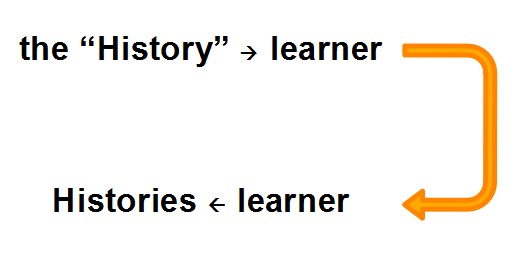
The curriculum is and will be prescribing the contents for history education in schools. The textbook is based on the curriculum and delivers “one” story that students are supposed to understand and to learn. Now, history education can change from this top down perspective to an approach where learning is based on the interests, questions and skills of the learners. It is all about activating and engaging the students: Not to ask them to sit and listen, but to make them do something; something which is meaningful to them. The compulsory topics of the curriculum stay the same, what changes is the way of approaching them. The following diagram resumes the main idea of this shift from teaching to learning:

history learnerDigitised sources and tools are used for digital storytelling. Nevertheless, the stories told by the students are not becoming arbitrary. There are criteria how to tell “history” as e.g. sourced based evidence, cogency and reasoning. Students have to be able to analyse sources, to identify and to discuss opinions and perspectives. History analysis as well as narrative techniques have be learned and practised to use them properly. So there is still a lot to do for the teacher. In addition, we need instruments to individually evaluate the skills of the learners to be able to help them improving.

Before finally talking about practical ideas for history lessons on the First World War, I would like to add some remarks about technical requirements:

Obviously, you need access to the internet. To do so you furthermore need a computer or other devices. To work individually or in pairs, you need a certain number of these devices. The equipment is different from school to school, though in general the standard is not to high and there are far less computers and devices than actually needed. One possibility is to allow the use of students‘ mobile devices in the classroom.

By then, you only have to provide computers or other devices for those who do not have one of their own. If you make a policy in your institution, it is called BYOD („Bring your own device“, see also the UNESCO publications on Mobile Learning). I know that in many, probably most of the schools this is not allowed. Students‘ devices are banned. Why? To me, it seems a question of perceiving these devices not only entertainment electronics but also as learning tools.

And what about this marvellous machine that will revolutionise teaching: the Interactive Whiteboard? Well, in my humble opinion, not much. If you start working with individual devices on a regular basis, it is pretty clever to use an interactive whiteboard every time you want to focus the attention of your students: for example, when introducing a topic, when explaining how to do something, to analyse a document all together or to present and discuss the student’s working results.

In a precise phase of a lesson an interactive whiteboard can be a powerful tool, however it is almost a misuse if its use brings us back to permanent lectures enriched now by pictures and films. Most of the whiteboard materials of the publishing houses work like this: They offer a complete structure for a lesson or even a whole teaching unit. You find a succession of prepared sheets where „interaction“ is restricted to the point that you can move an object, write down a word or click on the presentation to have an additional information. To me, this is not of much use. A powerful new tool is used to repeat the oldest way of teaching. If you want to talk about learning in the digital age, well, then talk about learning not about technology.

The third and last part will give some exemplary teaching ideas based on the given general remarks how to approach World War One in the history classroom using the Europeana Collections 1914-1918.

[Click here for part 3]

Working with the Europeana 1914-18 collections in the history classroom – Part 1/3: Scarcity vs. abundance

europeana 19141918The Europeana 1914-1918 project has collected and digitised tens of thousands of private objects on World War One within the past years and put them online. Are these collections of any use for learning history in school? I think yes, but to work with these sources history lessons have to change.

History teaching in school still is based mainly on textbooks, photocopies and maybe overhead transparencies. They offer a limited space. So teachers and students work with a reduced number of primary and secondary sources. In fact, the reduction seems in the first place quite an advantage – at least from the teacher’s point of view. The sources are already chosen and adopted to the use in school (transcripted, shortened etc.). The given materials are supposed to be relevant as they were chosen by the authors of the books based on the requirements of the curriculum. There are three inherent promises for the teacher: If you work with these sources 1) you can be sure to execute the curriculum, 2) you have less work and 3) you teach your students what is generally acknowleged as „important“ in history.

So everything is fine? Well, I am not so sure about it. I often hear pupils complain about being really interested in history but they say as subject in school history appears to be rather boring. That is why I would like to ask you to take closer look and to change the perspective to the pupil’s point of view.

Reading primary sources in the classroom often means nothing else than rephrasing the content of short snippets of texts which all look alike: a 18th century letter looks like a telegram or a medieval charter. In addition in many schoolbooks primary sources serve mainly as “source based evidence” for the presentation of history written by the schoolbook’s authors.

That is why two important things are often missing in the history classroom:

1) The students do not have to come up with their own questions about history – tasks and questions are also already given by the book or the teacher in accordance with the materials.

2) Therefore, one of the most important questions in the work of an historian almost never appears in the classroom: Is this source relevant to my question? Students do not have to check. The primary sources are printed in the book or on the photocopy because someone else judged them relevant.

Reading a source for evidence demands a different approach than reading a source for information. If you now take a look at the Europeana collections: You will find thousand of digitised sources. You cannot even see them all. There is an yet unseen abundance of primary sources available at your fingertips. They are all different. You find postcards, pictures, letters, diaries etc.; unfortunately, you cannot touch them but you can see that they are made of different materials having different sizes and colours.

And maybe more important: There is no fixed story in which the sources are integrated. It is up to you to establish historical significance. You are forced to, or I prefer to say, you are free to think about your questions on the First World War, and then look for answers in the documents. Finally you will write down the answer to your questions and give reasons for telling it the way you do. That is working like a historian, learning about how history is made – and every student can do it.

Putting a pupil in front of such an online collection of primary sources is much alike the situation of a historian in an archive. Yes, this is a difficult situation – but absolutely intriguing…

[Click here for part 2/3]

Digital Sources in Teaching and Learning History

Banner-Unlocking-Sources-500px

This is my presentation for next week’s conference  „Unlocking Sources – the First World War Online & Europeana“ in Berlin. The europeana collections 1914-1918 make hundreds of thousands of digitised sources available online. The presentation is about how can we use these sources in the history classroom and how this might change history education in schools. Any comments are appreciated.

Auswahl von Online-Materialien & digitalisierten Quellen zur Geschichte des 1. Weltkriegs

Der Erste Weltkrieg in Rheinland-Pfalz:
————
Bildpostkarten Universität Osnabrück: Der Erste Weltkrieg auf der Bildpostkarte

http://www.bildpostkarten.uni-osnabrueck.de/index.php?cat=142

BpB Dossier: Der Erste Weltkrieg

http://www.bpb.de/geschichte/deutsche-geschichte/ersterweltkrieg/

Deutsch-französisches Kriegsalbum

http://centenaire.org/de/international/das-deutsch-franzoesische-album-des-ersten-weltkriegs

DHM Der Weltkrieg1914-1918 Ereignis und Erinnerung

http://www.dhm.de/ausstellungen/der-erste-weltkrieg/ausstellung_ziele.html

Digitales Archiv Hessen-Darmstadt: Feldpostbriefe im 1. Weltkrieg

http://www.digada.de/wk1/kap2/feldpostbriefe.htm

European Film Gateway – First World War Collections

http://www.europeanfilmgateway.eu/about_efg/EFG1914collections

Europeana 1914-1918

http://europeana1914-1918.eu/de

Imperial War Museums – Google Art Project

http://www.google.com/culturalinstitute/collection/imperial-war-museums

Informationsportal Politische Bildung: Linksammlung 100 Jahre Erster Weltkrieg

http://www.politische-bildung.de/100_jahre_erster_weltkrieg.html

Feldpost 1916/17: Die Briefe und Tagebücher des Oberleutnants August Dänzer aus
Siebenbürgen und Rumänien

http://www.uni-cms.net/feldpostsammlung/

Feldpostbriefe. Lettres de poilus „…wer fällt, der stirbt den Heldentod“ (Deutschlandfunk)

http://www.dradio.de/dlf/sendungen/feldpost/index.html

Feldpostbriefe: Bernd Ulrich, Die Augenzeugen. Deutsche Feldpostbriefe in Kriegs- und Nachkriegszeit 1914-1933, Essen: Klartext Verlag 1997, online:

http://www.erster-weltkrieg.clio-online.de/default.aspx?tabid=40208182

Irland und der Erste Weltkrieg

http://www.irelandww1.org/

La grande guerre. A Global History of World War I

http://grandeguerre.hypotheses.org/

Over the Top. An Interactive Adventure. Canadian War Museum

http://www.warmuseum.ca/cwm/games/overtop/index_e.shtml

Stadterinnerungen des Ersten Weltkriegs: Le Havre und Koblenz

http://memoires-urbaines-premiere-guerre-mondiale.spip.ac-rouen.fr/

Supremacy 1914 – Online-Spiel

http://www.supremacy1914.de

Themenportal Erster Weltkrieg der Bibliothek für Zeitgeschichte in der WLB Stuttgart
Traces 1914 – Schülerprojekt

http://www.traces1914.eu/

Walter Koessler Project (Fotoalbum eines deutschen Soldaten)

http://wwiphotos.tumblr.com/

Wikimedia Commons: World War I

http://commons.wikimedia.org/wiki/World_War_I

————
Auch als Etherpad ergänz- und weitergebbar: http://geschichtsunterricht.titanpad.com/10

Bratkartoffeln und Hammelbeine

Nein, das ist kein Beitrag über Kochrezepte. Ich werde auch nicht von jetzt an, um mehr Leser zu finden, von Zeit zu Zeit Rezepte oder Tierbilder einstellen. Ausgelöst wurde dieser Beitrag vielmehr durch die Sendung Karambolage auf Arte von gestern. In einem kurzen Beitrag wurde dort die Redewendung: „Ich verstehe nur Bahnhof.“ erklärt, von der ich auch gedacht hätte, sie käme von der schlechten Qualität der Lautsprecher für die Ansagen aus den Bahnsteigen. Der Ursprung der Redewendung liegt aber wohl am Ende des Ersten Weltkriegs:

Um die wahre Erklärung zu finden, muss man allerdings bis ans Ende des ersten Weltkrieges zurückgehen. Die Soldaten, besser gesagt die Überlebenden, waren stark geschwächt und dachten alle nur an eins: nach Hause fahren. Nach Hause kam man aber nur mit Zug, der bekanntlich vom Bahnhof abfährt. Man erzählt daher, dass die Soldaten, wenn man sie auf irgendetwas ansprach, das nichts mit ihrer Heimkehr zu tun hatte, alle geantwortet hätten: „Ich verstehe nur Bahnhof“, im Sinne von : „Ich will nur das Wort Bahnhof hören, alles andere interessiert mich nicht“.

Auf Twitter kam dann von Manfred Koren der Hinweis, dass der Ausdruck „sich verfranzen“ gleichfalls auf den Ersten Weltkrieg zurückgehen soll:

Im ersten Weltkrieg hatte das Flugzeug zunächst die vornehmliche Aufgabe der Aufklärung. Hierzu war ein Flugzeug zumeist zweisitzig. Die Besatzungen bestanden aus einem Piloten und einem Navigator. Letzterer bediente sich einer groben Koppelnavigation mit Flugkarte, Daumen, Uhr und Kompass. Die grobe Koppelnavigation nannte man Franzen. Die Herkunft dieser Begrifflichkeit wird aus der Sprechgruppe „Franz“ im deutschen Flugfunk vermutet. Diese Sprechgruppe war für die Navigatoren der Flugzeuge zuständig. So bürgerte sich also der Name Franz für den Navigator ein. […] Verirrte sich nun eine Besatzung, so lag die Last beim Franz, weshalb der Emil schon mal sagen konnte, dass sich sein Franz „verfranzt“ habe. [Fliegerlexikon]

Jujoma wies gleichfalls über Twitter daraufhin, dass der bekannte Ausdruck 08/15 gleichfalls auf den Ersten Weltkrieg zurückgeht:

Es gibt drei Erklärungsansätze zur Entstehung der Redewendung. Alle stehen im Zusammenhang mit dem Maschinengewehr mit der Typenbezeichnung MG 08/15, das im Ersten Weltkrieg erstmals zum Einsatz kam. […] Verbreitung fand der Begriff auch durch die 1954 erschienene Romantrilogie 08/15von Hans Hellmut Kirst. Es war einer der ersten Bestseller der Bundesrepublik und wurde im selben Jahr unter demselben Titel verfilmt. [Wikipedia]

In einer schnellen Netzrecherche habe ich einige weitere Ausdrücke und Redewendungen gefunden, die auf den den Ersten Weltkrieg zurückgehen sollen und heute noch – mehr oder wenig – gebräuchlich sind:

Bratkartoffelverhältnis: Der Ausdruck stammt aus dem ersten Weltkrieg und bezeichnete damals eine kurzfristige Liebesbeziehung, die vor allem wegen besseren Verpflegung eingegangen wurde. Heute meist Synonym für eine „wilde Ehe“ [Fundstelle]

jemandem die Hammelbeine lang ziehen: jdn. scharf angehen oder schikanieren, laut Wikipedia aus der Soldatensprache des Ersten Weltkriegs. (Eine ganz andere Erklärung findet sich hier bei SWR2).

eine treulose Tomate: Der Ausdruck soll sich ausgehend vom Bündniswechsel Italiens von einer Bezeichnung für Italiener entwickelt haben. [Fundort, siehe auch Wikipedia]

Vermutlich gibt es noch mehr Ausdrücke und Redewendungen, die auf den Ersten Weltkrieg zurückgehen. Wer weitere kennt, bitte als Kommentar hinzufügen. So ließe sich eine kleine Sammlung anlegen. Die Ausdrücke und Redewendungen sind  insofern spannend, als sie zeigen, wie stark auch die Alltagssprache durch den Ersten Weltkrieg geprägt wurde. Zu überlegen wäre, ob eine oder mehrere dieser Redewendungen nicht auch für den Unterricht z.B. als Einstieg geeignet wären, um Interesse zu wecken oder darüber hinaus auch Teilaspekte des Ersten Weltkriegs zu thematisieren.


Rehabilitation 1914-18

In Ergänzung zu dem vorangegangenen Beitrag folgt hier nur der kurze Hinweis, dass es in Frankreich eine Bewegung gibt, die die Rehabilitation der „zur Aufrechterhaltung der Disziplin in der Truppe“ standrechtlich erschossenen Soldaten aus dem „Großen Krieg“ fordert. Die Gründe für die Verurteilung sind vielfältig. Für den Ersten Weltkrieg sind hier aber vor allem zu nennen Selbstverstümmelung (siehe auch das Buch bzw. den Film: Un long dimanche de fiançailles / Mathilde – eine große Liebe), Desertion, Verlassen des Postens sowie Ungehorsam vor dem Feind.

France3 berichtet über eine Kundgebung in Dijon, Burgund Unten auf der Seite sind ein paar interessante weiterführende Links angegeben. Die Materialien sind sicher auch interessant speziell für den bilingualen Fachunterricht. Zu dem Thema gibt es auch einen Artikel in der französischsprachigen Wikipedia, der recht detailliert, allerdings nicht mit anderen Sprachversionen verlinkt ist.

„Was uns der Lehrer über das Vaterland, über den Ruhm erzählt hat, ist dummes Zeug und Lügen.“ Pazifismus im Ersten Weltkrieg. Geschichte von unten – Unterrichtsmaterial zur Perspektivenerweiterung

Durch die online verfügbare Vorlesungsreihe zu Frankreich seit 1871 von John Merriman von der Yale Universität bin ich auf ein spannendes Buch aufmerksam geworden, das ich mit großem Gewinn gelesen habe. Es handelt sich um die Autobiographie von Emilie Carles, die Ende der 1970er Jahre in Frankreich erschien und ein Bestseller wurde. So gibt es sogar einige Schulen, die nach ihr benannt sind. In Deutschland ist sie dagegen kaum bekannt.

Emilie Carles ist im Jahr 1900 in einem kleinen Dorf in den französischen Hochalpen geboren. Trotz zahlreicher Probleme und Widerstände kann sie ihre Ausbildung über die Grundschule hinaus fortsetzen und nach Paris gehen, um selbst Lehrerin zu werden. Zwei Jahre vor ihrem Tod 1979 hat sie mit „Une soupe aux herbes sauvages“ (sinngemäß: eine Wildkräutersuppe) eine Autobiographie veröffentlicht, in der sie nicht nur ihr Leben, sondern auch den Alltag der dörflichen Bevölkerung zu Beginn des 20. Jahrhunderts sehr ausführlich und eindrucksvoll schildert.

Da ich zeitgleich zum Lesen des Buchs an Material zum Ersten Weltkrieg gearbeitet habe, sind mir zwei Passagen besonders aufgefallen, in denen sie Erinnerungen an diese Zeit wieder gibt. Meines Erachtens eignen sich beide Stellen, um der Narration der Schulbücher eine sonst wenig beachtete Perspektive hinzufügen, die weitere Fragen provoziert, zu denen die Schülerinnen und Schüler dann recherchieren und diskutieren können.

Da die wenigsten das Buch ganz oder in Auszügen im bilingualen Unterricht lesen können, habe ich die zwei Passagen übersetzt, um sie für den Geschichtsunterricht nutzbar zu machen. Ich bin kein professioneller Übersetzer, daher ist die Übersetzung sicher an einigen Stellen hoplrig, an anderen vielleicht etwas frei. Ich hoffe, dass die Texte in der Form trotzdem etwas taugen. Beide übersetzte Passagen stelle ich hier im Blog zum Download als Textdatei im ODT-Format ein, so dass die Auszüge ggf. noch bearbeitet, gekürzt und mit eigenen Aufgabenstellungen versehen werden können.

Der erste Auszug (Download) beschäftigt sich mit dem Fronturlaub des Bruders von Emilie Carles, den sich nach einem Jahr im Krieg zum ersten Mal wiedersieht und an ihm starke Veränderungen beobachtet. Nach ihrer Erinnerung hat ihr Bruder ihr bei diesem Treffen eine pazifistische Botschaft und einen klaren Auftrag mitgebracht. Die Desillusionierung im Kriegsverlauf, die Situation der Frontsoldaten wird in diesem Abschnitt sehr anschaulich und es stellt sich die Frage, warum der Bruder trotz seiner Erkenntnisse, wie andere auch, an die Front zurückkehrt und weiterkämpft.

Hier schließt eine zweite Passage (Download) an, in der Emilie Carles ihre Erinnerungen an eine Begegnung mit einem älteren Freund nach dem Krieg aufgeschrieben hat. In ihrer Zeit in Paris hatte sie Anschluss an die politischen Kreise der Pazifisten und Anarchisten gefunden. Ihr Leben und Werk ist durchdrungen von einer überzeugten pazifistischen Grundhaltung, deren Entstehung sie an dieser Stelle in ihrer Biographie nachzeichnet. Die wiedergegebene Rede ist als Quelle zunächst einmal kritisch einzuordnen – gerade auch angesichts der vielen sprachlichen Übereinstimmungen mit der referierten Erzählung ihres Bruders -, birgt aber mit der massiven Kritik am nationalen Erziehungssystem und der positiven Deutung der „Fahnenflucht“ einen guten Ausgangspunkt für weitere Recherchen zu Historie der Kriegsdienst-Verweigerung als alternative „Kriegs“-Geschichte sowie zu einer kritischen Diskussion über die vortragenen Positionen sowohl in ihrem historischen Kontext des Ersten Weltkriegs wie auch in ihrer Bedeutung für die Gegenwart.

P.S. Je nach Unterrichtsschwerpunkt könnte das Thema am historischen und heutigen Umgang mit Wehrmachtsdeserteuren vertieft werden.